Beyond the technical: INFINITY takes the stage in Tallinn for Digital Heritage Ethics
Digital cultural heritage risks becoming a distorted echo of the past if built on fragmented data. At the DIGHT-Net Seminar in Tallinn, INFINITY Project Coordinator Valentina Presutti argued that data quality isn’t just a technical detail—it is an ethical obligation for Europe’s digital future.
Highlighting the “Invisible” Responsibilities of AI
The dissemination activities of the INFINITY project continue at a fast pace. On April 17, 2026, Valentina Presutti from the University of Bologna delivered a keynote at the Frontiers in Digital Cultural Heritage seminar hosted by Tallinn University.
In her talk, titled “Data Quality and Ethics in Cultural Heritage Knowledge Graphs,” Presutti addressed a critical issue: Knowledge Graphs (KGs) do more than just link databases; they actively shape historical narratives and directly determine whether the AI systems of tomorrow will be reliable or biased. Massive investments over the last two decades have provided unprecedented remote access to cultural resources, but without critical technical intervention, we risk automating systemic bias.
The technical meets the ethical: lessons from ArCo and ChoCo
Drawing from the research foundation that powers INFINITY’s neuro-symbolic approach, the presentation explored how to manage data quality across two main dimensions:
- The Technical Challenge (Extreme Heterogeneity & Inconsistency): data exists in countless incompatible formats. Presutti highlighted ChoCo, a Knowledge Graph that integrated 18 disconnected music datasets using different notations , and ArCo, which transformed the entire official Italian Cultural Heritage Catalogue into a scalable semantic network despite varying field granularity.
- The Ethical Dimension (The Coded Gaze): technical quality control is deeply linked to cultural biases. For example, historical records like the Benin Bronzes are often described in museum labels as simply “collected in 1897,” effectively hiding the political reality that they were looted. Visuality and categorization are cultural practices, not neutral facts.
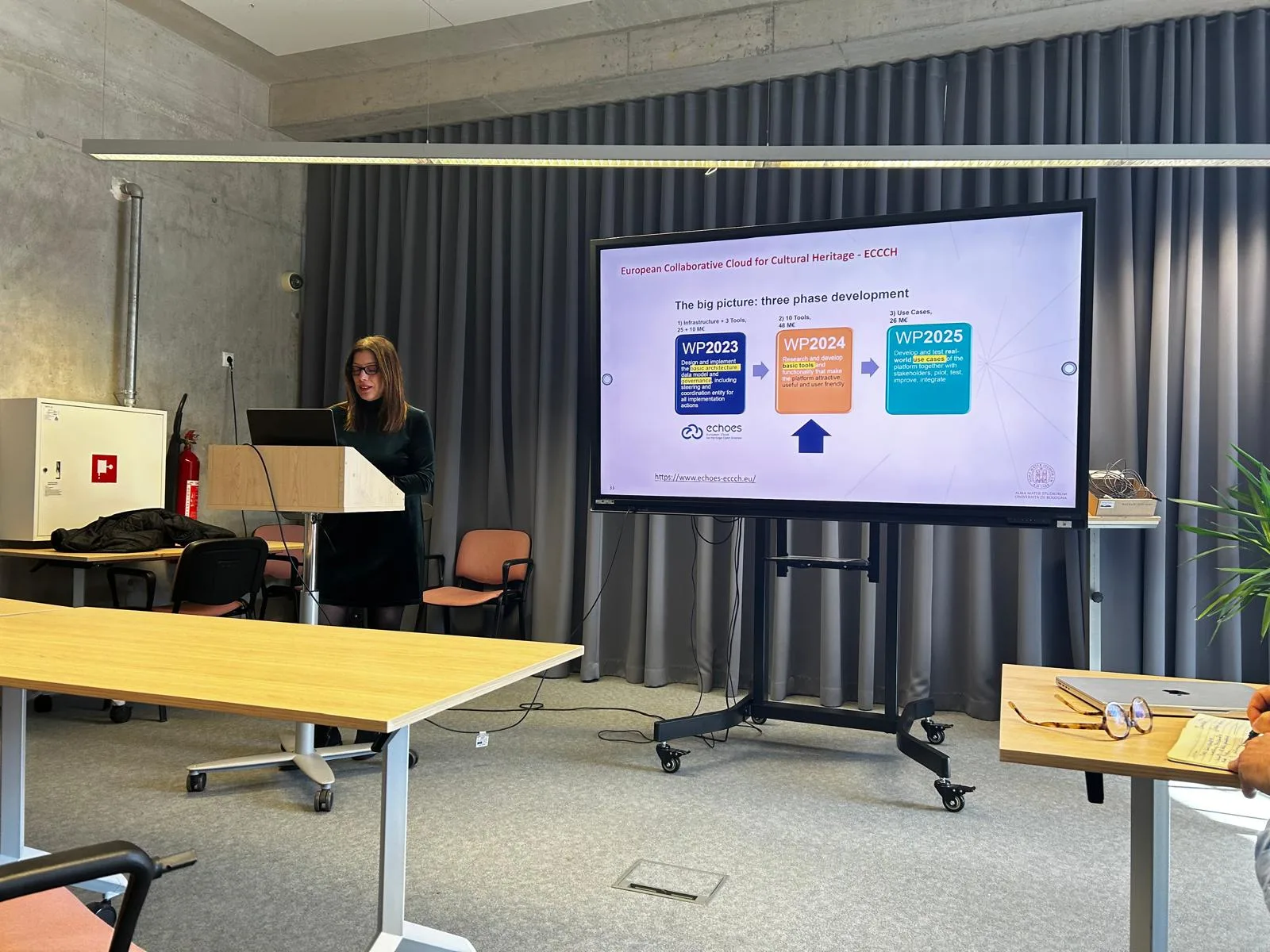
Valentina Presutti from the University of Bologna
The INFINITY Solution: modeling the “Annotation Situation”
To address these challenges, the talk showcased how next-generation ecosystems must evolve . While structural standardization tools like ChoCo’s JAMifier or Chonverter align formats, a massive provenance gap still remains across global datasets.
INFINITY addresses this “trust deficit” by moving from asserting cold facts to Contextualizing Beliefs . Through advanced Multidimensional Knowledge Graphs (mKGs), our tools model the entire Annotation Situation—capturing Who made the label, When, and For What Purpose . This allows contested viewpoints to co-exist transparently, capturing data provenance alongside human and machine-driven metadata lifecycles.
A Collective Responsibility for the ECCCH
This keynote highlights INFINITY’s mission to make ethical practice and multi-perspectivity the native default within the European Collaborative Cloud for Cultural Heritage (ECCCH) ammiraglia framework . Closing the gap between cutting-edge technology and the humanities requires true interdisciplinary alignment between heritage experts, AI researchers, ethicists, and policymakers.
As we scale up our five real-world use cases—ranging from [CROWD]’s public post-WWII citizen science campaigns to [AUDIOVISUAL]’s copyright-aware video tracking—the insights shared in Tallinn will directly guide our software engineering rulebooks.